India’s aviation problem is not demand. It is operational resilience.
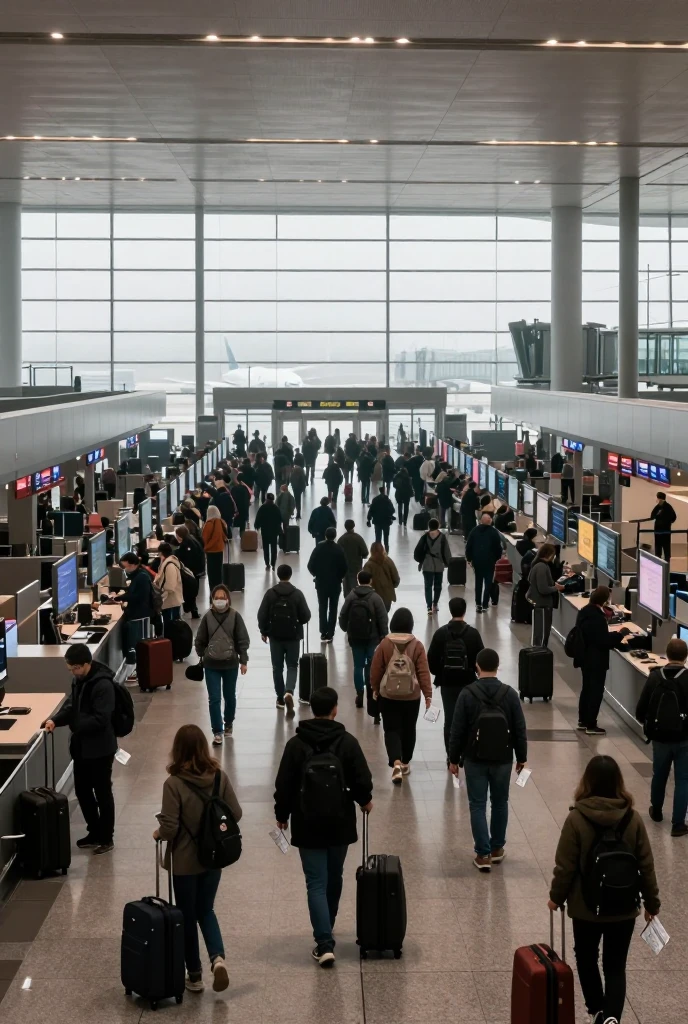
Planes are full, new routes are announced every season, and airport terminals look like railway stations in the 1990s overflowing, chaotic, alive. For a country that once treated air travel as a luxury, India has achieved something remarkable. Flying has become normal. But scratch the surface of that success, and a more uncomfortable truth emerges. Our real bottleneck is not how many people want to fly. It is how fragile the system becomes the moment anything goes wrong.
Fog in Delhi. A runway excursion in Mumbai. A crew stuck beyond duty hours in Bengaluru. A radar glitch, a fuel price spike, a grounded aircraft, a sudden ATC restriction. Each of these, in a resilient system, is a local problem. In India’s aviation ecosystem, they become national spectacles like mass delays, rolling cancellations, stranded passengers, and a round of blame-shifting between airlines, airports, regulators, and the weather gods.
India’s skies don’t suffer from a lack of passengers. They suffer from a lack of slack.
We like to say safety is non-negotiable. In practice, it is where the stress lines show first.
In a system designed for resilience, you assume things will go wrong. A bird strike, a sudden wind shift, a minor tech snag, a fatigued pilot who calls unfit. You build buffers in staffing, scheduling, maintenance, and infrastructure so that when that happens, the system bends but does not break.
In our current configuration, those buffers are razor-thin.
Pilots are rostered to the legal limit, then asked, tacitly or explicitly, to 'help the operation' when the network melts down. Maintenance windows are planned around maximum aircraft utilisation, not generous margins. ATC and airport teams work at traffic levels that leave very little room for error or outage. On paper, this is efficiency. In real life, it’s a constant flirtation with the limits of human performance and system capacity.
The danger is not just a major accident. The daily grind of minor incidents and near-misses that never make the news is the real indicator of resilience. Do we have a culture where we report, investigate, and use these to address systemic weaknesses? Or do they get buried because nobody has the time, money, or political appetite to admit how close to the edge we are running?
Without resilience, 'safety first' easily degenerates into “safety as long as everything else goes to plan.”
Cheap tickets, costly brittleness
Everyone loves cheap tickets. So do Indians. Indians love a cheap fare, and politicians love being seen as protectors of the common flyer. That combination has baked a distortion into the market. Low prices are treated as sacrosanct, but reliability and resilience are treated as optional.
Airlines operate under high input costs, tax-heavy fuel, and a structurally weak rupee, while being punished in the market for raising fares. Something has to give. The easiest place to squeeze is the invisible buffer when turnarounds get tighter. Spare aircraft become a luxury. Standby crews are reduced to the bare minimum. Schedule padding critical to absorb routine delays, is trimmed.
On normal days, this looks like smart optimisation. On bad days, it looks like total collapse. A single grounded jet or an unplanned maintenance issue quickly snowballs into dozens of delayed flights because there is no backup capacity. Passengers, who thought they were paying less for the same service, discover they’re actually paying less for a far more fragile promise.
Operational resilience costs money. It means funding spare capacity that sits idle most of the time. It means investing in better systems, deeper training, more robust maintenance, and actual contingency planning. If we refuse to acknowledge that cost, we condemn ourselves to a cycle where every disruption becomes a crisis and every crisis erodes public trust.
Human bandwidth is not infinite
Behind every on-time departure board is a crowd of humans pilots, cabin crew, engineers, ground handlers, ATC officers, dispatchers, security, and airport ops. When growth outpaces training and retention, these people become the 'shock absorbers' the system lacks elsewhere.
They stretch duty times to the limit, rotate through disrupted rosters, agree to last-minute changes, and absorb passenger anger on the front lines. Burnout is not an abstract HR term here, it is a safety variable.
India has produced large numbers of aviation professionals in a relatively short time. But depth of experience cannot be rushed. When upgrades are accelerated, when new bases open faster than instructors can train, when salaries don’t reflect stress, and when fatigue reporting is quietly discouraged, you’re no longer running a resilient operation, you’re running a high-tempo experiment on human limits.
A mature system doesn’t just count heads. It protects rest, listens to fatigue reports, and treats “no” from a tired captain or controller as a safety asset, not a nuisance. Until that mindset becomes the norm, every foggy morning and every congested evening wave will test not just our infrastructure but our people’s breaking point.
Infrastructure: one glitch, nationwide shockwave
Then there is the hard skeleton--runways, taxiways, terminals, radar, and data systems.
India’s major airports are already straining at peak. Runways are intensely used, with little redundancy if one closes. Taxiway and apron layouts often reflect historical constraints, not optimal modern flows. Terminals that looked futuristic at inauguration now feel cramped and under-served.
In such an environment, a single runway excursion, a disabled aircraft, or prolonged low-visibility operations do not remain local stories. It sends aircraft into diversions, crews out of position, rotations spiraling, and passengers into endless queues for rebooking and refunds.
Technology can help. Real-time data sharing between airlines, airports, and ATC. Better slot management. Predictive models for weather and demand. But technology bolted onto a system that has no willingness to maintain spare capacity is a band-aid, not a cure.
The missing word in Indian aviation debate
The Indian aviation conversation loves buzzwords like growth, connectivity, affordability, competition, capacity, efficiency. The word you seldom hear is resilience.
Resilience is the ability of the system to absorb a shock, adapt, and recover without catastrophic failure while keeping safety as a hard limit, not a variable. It is not glamorous. It doesn’t photograph as well as ribbon-cuttings and aircraft order signings. But it is what separates a truly mature aviation market from a perpetually adolescent one.
Right now, we have built a race car and are driving it like a city bus. Maximum load, minimum margin, constant improvisation. It makes for good short-term optics and dangerous long-term dynamics. If India wants its aviation story to be more than a numbers game of passengers and planes, it has to start asking different questions. How much slack is intentionally built into schedules, staffing, and infrastructure? Who is accountable for resilience, not just for growth? What regulatory and pricing frameworks explicitly recognize the cost of reliability, not just the politics of cheap fares?
The real measure of our aviation maturity will not be how many people we can get into the air, but how calmly and safely we can bring them home when the sky stops cooperating.