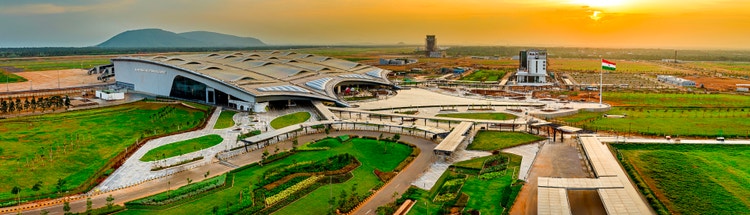
Scheduled commercial flights have left the civil enclave at Visakhapatnam’s INS Dega for the new Alluri Sitarama Raju International Airport at Bhogapuram. The IATA code and airline schedules moved with them. What remains at the naval air station is a mixed environment: non-scheduled commercial operations, charter and private flights, VIP and government movements, police and defence activity, and the full range of naval flying. The arrangement is deliberate. Gazette notifications closed the enclave to scheduled passenger services for decades while explicitly preserving non-scheduled civil flying and military use. The result is a rare Indian experiment in an airport that is no longer a dual-use airline hub but still a dual-use aviation base.
Once the daily airline banks disappear, the character of the airfield changes. Business aviation and charters gain easier access to slots and ground handling that were previously subordinated to airline peaks. Medical evacuation and organ-transport flights can operate with fewer conflicts. Special missions, disaster-response staging and police aviation find a facility already equipped for security and rapid turnaround. Maintenance and pilot-training activity can expand without the pressure of commercial passenger schedules. For the Indian Navy the removal of scheduled civil traffic simplifies airspace management and operational priority at a key coastal base.
The strategic value lies in whether this model can be repeated. Several Indian cities still share civil enclaves with defence airfields. As greenfield civilian airports open, the older joint facilities face a choice: close the civil side entirely, or retain a focused general-aviation, charter and special-mission role. INS Dega offers a live test of the second path. Success would mean sustained non-scheduled traffic, clear procedures between naval and civil users, and enough economic activity—charter, training, MRO, emergency response—to justify keeping the civil infrastructure alive. Failure would mean a quiet residual facility used mainly for occasional VIP and military support.
For India’s wider airport system the lesson is practical. Capacity pressure at defence-linked civilian airports is not only solved by building new passenger terminals elsewhere. It can also be eased by redefining the residual airfield as a specialist base for the traffic that does not need a full airline hub: business jets, air ambulances, training aircraft, disaster-relief staging and security operations. Vizag’s old airport has lost its airlines. What it may gain is a clearer identity as one of the country’s most strategically useful general-aviation and mixed-use bases—if operators, the Navy and regulators treat the residual civil role as a deliberate design rather than an afterthought.
**Sources** Ministry of Civil Aviation gazette notifications on the transfer of scheduled commercial operations and the VTZ code from Visakhapatnam (INS Dega) to Bhogapuram, Airports Authority of India statements, and contemporaneous reporting on the continuation of non-scheduled, VIP, police and defence activity at the civil enclave.