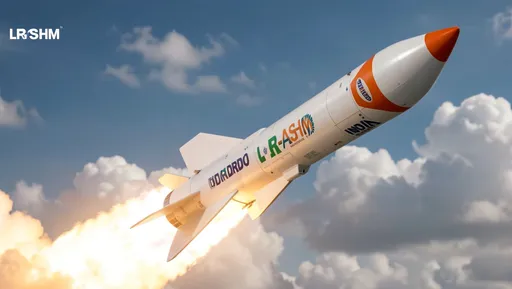
India’s unveiling of the LR-AShM hypersonic glide missile during the Republic Day parade in January 2026 sent a clear message about the country’s evolving approach to strategic deterrence. Mounted on a heavy transporter-erector-launcher and rolling down Kartavya Path alongside other advanced systems, the weapon represented India’s entry into the exclusive group of nations capable of fielding long-range hypersonic strike options. With a reach beyond 1,500 kilometres and peak velocities approaching Mach 10, the missile gives Indian forces the ability to hold high-value naval targets at risk across wide expanses of ocean, fundamentally altering how potential adversaries must calculate the costs of confrontation in the Indian Ocean Region.
The LR-AShM’s design as a boost-glide system allows it to achieve hypersonic speeds early in flight before transitioning to an unpowered glide phase marked by atmospheric skips. This profile, combined with low-altitude maneuverability and indigenous terminal sensors, makes the weapon exceptionally difficult to detect and intercept during most of its trajectory. For deterrence purposes, that combination is powerful. An adversary contemplating the deployment of carrier strike groups or other major surface formations into contested waters now faces the prospect of rapid, precise strikes launched from Indian territory or naval platforms that can arrive before effective countermeasures can be fully organised. The missile does not need to be used to achieve its primary strategic effect. Its mere existence and demonstrated progress force opposing planners to allocate greater resources to defence, dispersal and early warning, thereby raising the threshold for any aggressive action.
The second developmental test conducted off the Odisha coast in May 2026 reinforced this deterrent value. Successful validation of key glide and guidance elements moved the programme closer to operational maturity and signalled to regional powers that India’s hypersonic capability is advancing on a credible timeline. In strategic terms, such tests serve as visible demonstrations of resolve and technical competence. They communicate that India possesses both the industrial base and the political will to field weapons that compress response times and expand strike options in ways that legacy subsonic or even supersonic systems cannot match. This matters particularly in a maritime domain where distances are vast and the ability to project power quickly can determine whether a crisis escalates or remains contained.
The LR-AShM strengthens India’s overall deterrence posture by contributing to a layered approach that combines conventional precision strike with the psychological and operational advantages of hypersonic speed. Potential adversaries must now account for the possibility that key naval assets could be neutralised from standoff ranges with minimal warning, complicating their own force employment and raising the risks associated with any attempt to coerce or threaten Indian interests at sea. This capability aligns with a broader national strategy aimed at maintaining stability through credible strength rather than through reactive measures alone. It also supports India’s role as a net security provider in the Indian Ocean by deterring extra-regional actors from actions that could disrupt vital sea lanes or challenge the regional balance.
As development continues, the missile’s integration into naval and potentially joint-service concepts will further amplify its deterrent effect. Commanders gain new tools for shaping the battlespace at the outset of any conflict, while political leadership acquires additional options short of escalation to higher levels of force. In an environment where technological edges can shift rapidly, the LR-AShM represents a deliberate step toward ensuring that India’s deterrence remains robust against both current and emerging threats.