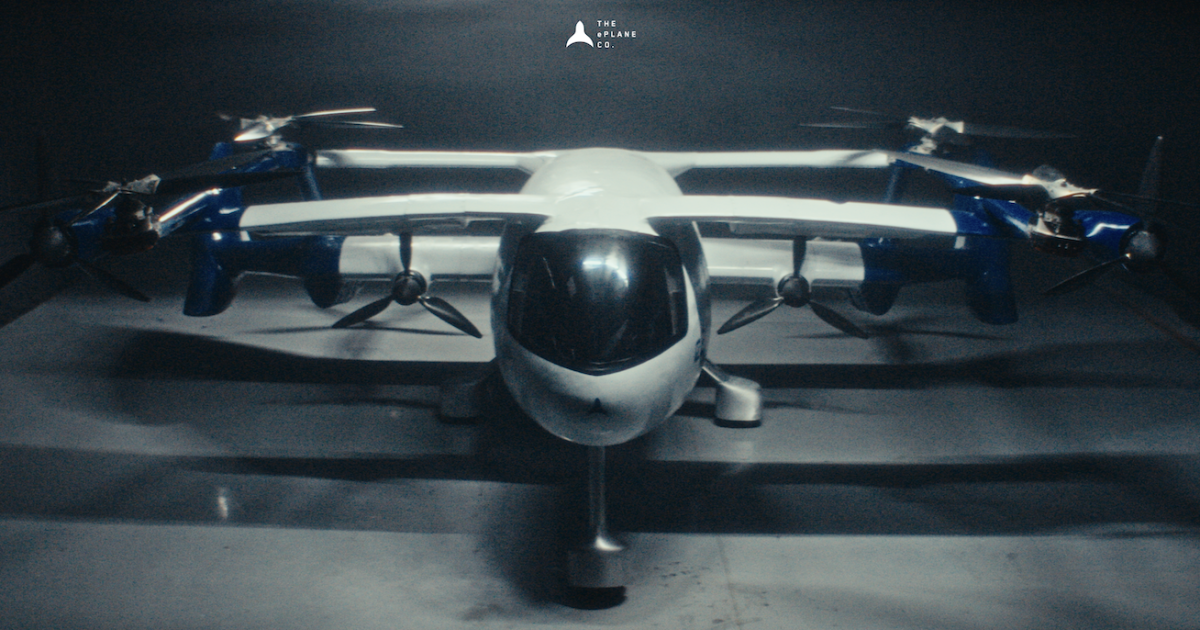
India’s most credible early eVTOL market may not be the glamorous air taxi. It may be the medical mission, where saving time has an obvious value, passengers do not need to be persuaded to pay for novelty, and an operator can begin with a small number of carefully chosen routes.
The ePlane Company, a Chennai based developer incubated at IIT Madras, is targeting April 2027 for flight testing of its e200X certification conforming prototype. Rather than entering the crowded urban air taxi race first, the company says it plans to pursue air ambulance certification before moving into two passenger and later four passenger transport variants.
That is a more realistic sequencing strategy than the usual promise of commuters flying above city traffic. Air taxis must solve several difficult problems at once. They need a certified aircraft, reliable battery performance, trained pilots or approved automation, vertiports, charging infrastructure, airspace procedures, passenger demand and fares that are high enough to support the service without making it too exclusive to use.
Medical transport begins with a clearer reason to pay. In a trauma case, stroke emergency, cardiac incident, organ transfer or urgent inter-hospital movement, time is not merely a matter of convenience. It can affect clinical outcomes. An aircraft that can bypass road congestion and connect a smaller hospital to a trauma centre may therefore have a more defensible operating cost than one carrying a commuter to an office meeting.
The e200X has not yet flown. Its full scale prototype is in ground testing, and the company must still pass through component tests, a preliminary design review, ground validation, flight testing and the wider DGCA type certification process. That makes 2027 a target, not a guarantee.
But the choice of mission matters. An air ambulance service does not need to build a citywide passenger network from the first day. It can begin with defined hospital corridors, a limited number of landing points, trained medical partners and dispatch systems designed around urgent cases.
That makes infrastructure more manageable. A conventional urban air taxi network may eventually need multiple vertiports near business districts, railway stations, airports and residential areas. Medical operations can initially focus on hospital campuses, airport sites and selected emergency transfer points. The landing infrastructure still needs safety approvals, fire protection, charging, security, airspace coordination and reliable communications. But the network can be smaller and built around demonstrable need.
The ePlane Company has already signed a memorandum of understanding with Noida International Airport to develop operational procedures, vertiport management systems and ground infrastructure for the e200X. The arrangement includes potential airport transfers, intra city operations and emergency air ambulance services, with space proposed for proof of concept activity, vertiports and charging stations.
It has also entered into a collaboration with Apollo Hospitals to explore e200X medical operations and drone based medical deliveries. The planned uses include emergency patient transfer, trauma response, cardiac and stroke cases, organ transport and links between high density urban corridors and harder to reach locations.
These agreements are not operating services. They are groundwork. Their value lies in moving the conversation away from aircraft renderings and toward the practical system an air ambulance needs, including hospital acceptance, dispatch protocols, landing sites, safety procedures, patient handover, regulator approval and clinical equipment integration.
That distinction is essential. An eVTOL capable of taking off vertically is not automatically an air ambulance. The operator must show that the aircraft can carry a patient, stretcher, paramedic, medical equipment and pilot within its weight and balance limits. It must prove that the cabin works for emergency care, that batteries and propulsion have adequate reserves, and that the aircraft can operate safely in the conditions in which emergencies actually occur.
Weather is an obvious challenge. Medical demand does not stop because visibility is poor, temperatures are high or monsoon conditions are difficult. The aircraft must have credible operating limits, alternate plans and clear criteria for when the patient should travel by road, helicopter or conventional fixed wing ambulance instead.
There is also an economic reality. Electric aircraft may eventually offer lower energy and maintenance costs than helicopters, but that does not make them inexpensive. The service will still need pilots, maintenance staff, medical personnel, charging systems, insurance, regulatory compliance, dispatch capability and standby capacity. Emergency transport is not like scheduled commuter aviation. Aircraft and crews may need to be ready even when they are not flying.
That is why medical transport offers a stronger first use case, not an easy one. The mission can support higher cost because the customer is buying time in urgent circumstances. It can begin on fixed corridors where the savings over road travel are measurable. It can use institutional buyers such as hospital groups, insurers, emergency networks and state health systems rather than relying only on individual passengers.
India’s road congestion makes the proposition more compelling. In a major city, moving a patient even a short distance can take an unpredictable amount of time. Between cities, the problem is larger. A patient in a smaller hospital may need rapid transfer to a specialist centre, but roads, traffic and geography can turn a clinically urgent journey into a long and uncertain one.
The eVTOL will not replace ambulances, helicopters or conventional air ambulances. Road vehicles will remain essential for the vast majority of emergency calls. Helicopters and fixed wing aircraft will continue to serve missions beyond an eVTOL’s range or payload. But an electric vertical lift aircraft could fill a gap between them, particularly for short to medium distance transfers where roads are slow and conventional helicopters are too expensive or operationally complex.
India’s eVTOL story will still generate air taxi headlines. Those aircraft are visually compelling, and the prospect of flying above traffic is easy to market. But the harder and more useful question is where the technology creates enough real value to justify its cost and complexity.
For now, that answer may be a patient on a stretcher, not a passenger on the way to a meeting.