India’s richest flyers are not just moving to the front of the cabin any more. They are walking out of the terminal altogether. Over the past few years, the country’s ultra‑wealthy have started peeling away from commercial first and business class, and into a parallel ecosystem of Gulfstreams, Globals and Falcons that rarely show up on airline spreadsheets but are reshaping the top end of Indian aviation.
Start with the money. India’s high‑net‑worth individual (HNWI) population grew 3 percent in 2025 to about 390,000 people, with their financial wealth rising 4.6 percent to roughly 1.64 trillion dollars. Within that, the ultra‑high‑net‑worth people worth more than 30 million dollars is expanding even faster. By early 2026, India was home to around 20,000 UHNWIs, ranking sixth globally, after a sharp multi‑year surge. Knight Frank and other wealth reports project that India’s UHNWI population will grow another 50 percent by 2028, the fastest rate in the world.
Those curves have a visible echo on the ramp. According to Asian Sky Group data, India ended 2024 with 168 business jets, the largest fleet in South Asia and the third‑largest in the Asia–Pacific, having added a net 18 aircraft in a single year. Between 2021 and 2024, the business jet fleet expanded by almost 25 percent, even as China’s shrank by about one‑third. Broader private aircraft counts including turboprops and helicopters put India at over 490 private aircraft in 2024, with projections of more than 700 by 2029.
The money flowing through that niche is no longer trivial. SBS Aviation estimates India’s private jet market grew from 187 million dollars in FY19 to 274 million dollars in FY24, an 8 percent annual growth rate, and is now expected to grow 13–15 percent a year to reach 500–550 million dollars by FY29. IMARC values the India business jet market at around 650–690 million dollars in 2024–25 and sees it rising to about 1.1–1.2 billion dollars by the early 2030s. Market Research Future projects the wider air charter services market going from 2.99 billion dollars in 2023 to over 9.2 billion dollars by 2035. Commentary from charter brokers and business aviation consultants describes India as the world’s fastest‑growing private jet market, with corporate charter requests tripling in 2025 and monthly private flights more than doubling to well over 2,400–2,700 movements.
India's very top of the wealth pyramid is growing at high single digits every year, and the business jet market is growing in the mid-teen range.
For the UHNW set, the trade‑off has shifted. A return first‑class ticket from Mumbai to London or New York on a top carrier can comfortably run into multiple lakhs per person. For a family office that now manages hundreds of crores, factors in time savings, privacy, the ability to route into smaller airports closer to factories or mines or project sites.
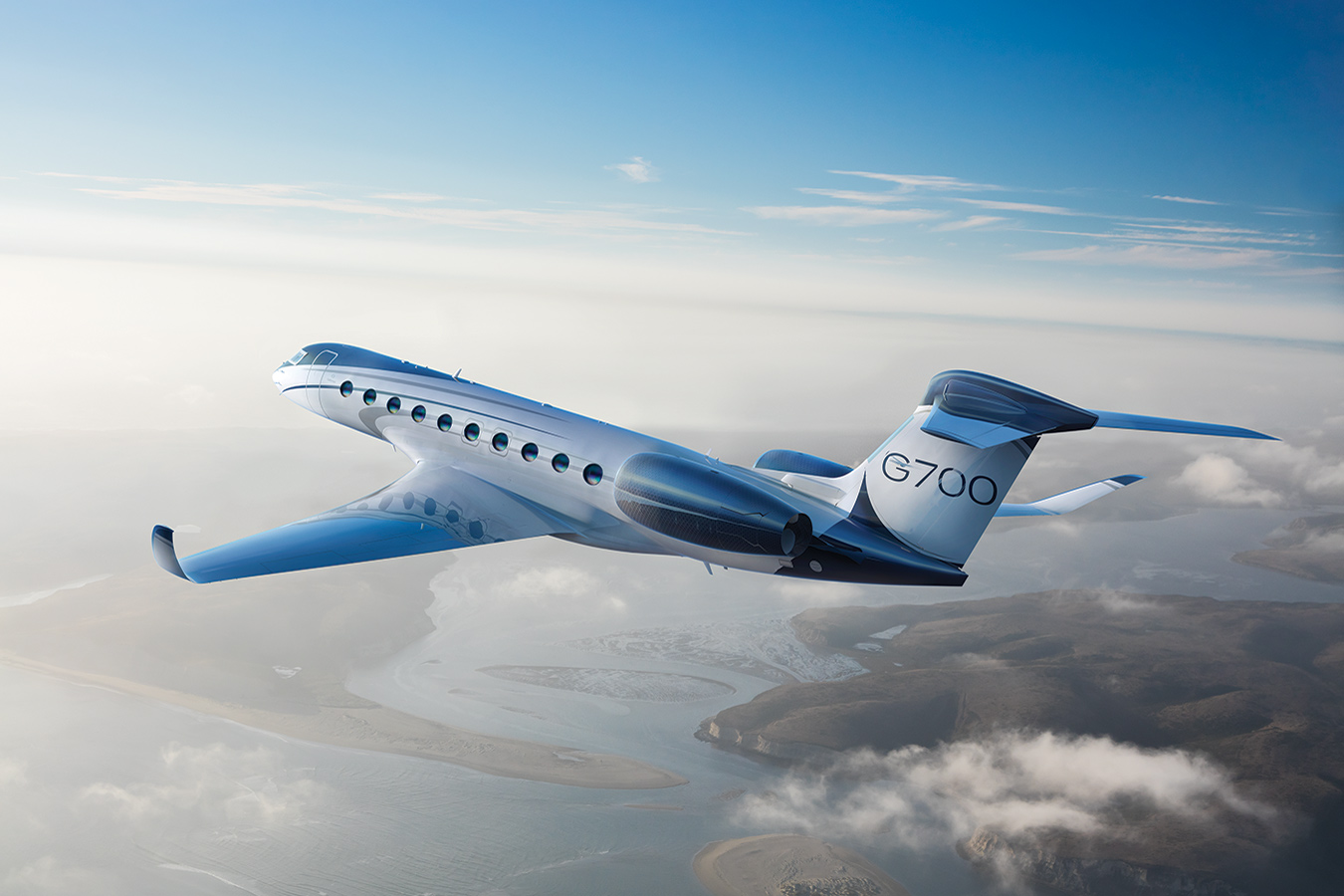
The Gulfstream G700 sits right at the point where aspiration and utility meet. While exact Indian customer lists are private, the type is effectively the “it” jet in upper‑crust boardroom talk: 7,500 nautical miles of range at long‑range cruise, enough to fly Mumbai–New York or Delhi–San Francisco with margin; a large, four‑zone cabin with a proper bedroom and shower option; and performance that lets it use shorter runways than an airliner while still cruising near Mach 0.9. Some Indian UHNW families have opted for Bombardier Global 7500s or Dassault Falcon 8X/10X. Others rely on chartered capacity instead of outright ownership, but the cultural reference point has clearly shifted from 'I flew first on Emirates' to 'we took the G'.
Even without naming specific owners, you can see the scale by looking at fleets like Reliance Industries, which as of 2025 was reported to operate 14 jets and 3 helicopters, including Global 7500s, corporate airliners like an ACJ319 and BBJ MAX 9, and multiple large‑cabin business jets. That is an extreme example.
The first is that top‑end growth is bifurcating. The same wealth reports that show explosive growth in UHNWIs also show a broader swell in lower‑tier millionaires and affluent professionals: Knight Frank put India’s HNWI count around 85,698 in 2024, expected to rise to almost 94,000 by 2028. Capgemini notes 390,100 HNWIs in 2025, up 3 percent, with their wealth up 4.6 percent.
When corporate houses and UHNW families start treating private aviation as default for key trips, their spend stops appearing as first‑class revenue and instead flows into charter and management companies. Over a decade, that can change the economics of offering very small, extremely expensive first‑class cabins.
Most Indians will never set foot in a G700 or Global 7500. Their aviation story will be written on 180‑seat narrowbodies and in the back of a queue at a busy terminal. But at the edge of the system, the behaviour of a relatively small number of families and firms is reshaping the top of the market. Every time a Gulfstream lifts from a private terminal at Delhi or Mumbai instead of four first‑class seats being sold on a scheduled flight, it is a quiet datapoint in a larger shift. The richest Indians are not just buying better seats any more. In increasing numbers, they are buying their own sky.