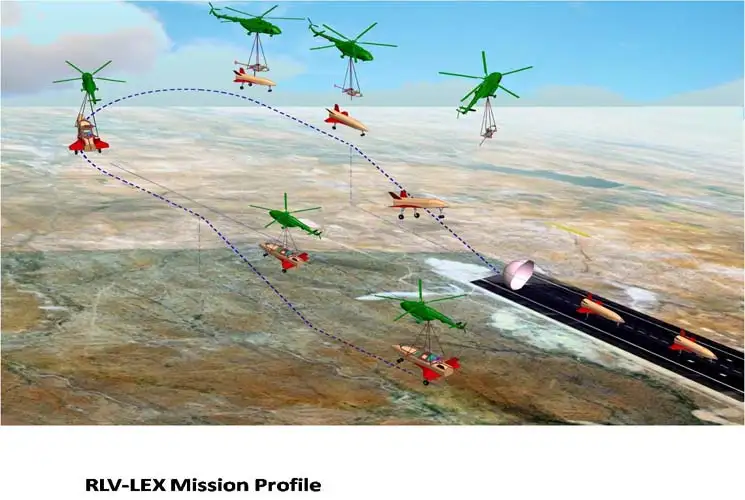
ISRO’s Reusable Launch Vehicle Technology Demonstrator (RLV‑TD) is no longer a quirky science project. Today, it is the backbone of a deliberate plan to give India something it has never had before. A reusable launch architecture aimed at the same cost regime that made Falcon 9 dominant. With its third autonomous runway-landing test to go, the programme has quietly crossed an important psychological threshold that India can now fly a winged re‑entry vehicle back to a runway, under its own guidance after hypersonic flight. That doesn’t make PSLV or LVM3 reusable overnight but it does mean the 'we don’t have the tech' caveat has expired. Now, 'we have the robust tech.'
Let's separate 'demonstrator' from 'workhorse'. RLV‑TD which is also nicknamed 'Pushpak' is a winged spaceplane with indeginous Indian guidance, navigation and control can precisely steer a lifting body back to a runway and that it's thermal protection system can ride out a high‑energy return and it's avionics stack can autonomously manage the entire flare and touchdown without a pilot on board. ISRO has tested these with its testing experiments. The government described the next step explicitly is a winged Orbital Re‑entry Vehicle launched on top of a rocket inserted into orbit then flown back to an airstrip using the RLV‑TD flights as technology pathfinders.
In parallel, ISRO leadership has said that the agency plans to design and build a new reusable rocket for the global market, effectively a post‑LVM3 launcher in which reusability is baked into the design from day one. The roadmap points to a next‑generation vehicle with semi‑cryogenic propulsion, a reusable first stage likely via powered descent and landing at sea, and, a recoverable upper stage using RLV‑style winged technology. The target in broad terms is to drag India’s cost to orbit down from the traditional USD 10,000–15,000 per kilogram band towards USD 5,000/kg and ultimately the USD 1,000/kg frontier. Those numbers are aspirational, but they tell you the direction of travel. Indian reusability is being justified in Falcon-class economics.
What would such a rocket actually do to India’s commercial launch position? Right now, ISRO’s value proposition rests on frugal expendables. PSLV is widely estimated at roughly USD 4,500–5,000 per kg, LVM3 closer to USD 15,000 per kg for heavy missions. Falcon 9, by contrast, sits around USD 5,000 per kg while re-flying boosters many times, and SpaceX amortises development costs across an enormous flight rate. NSIL, ISRO’s commercial arm, operates at annual revenues in the hundreds of millions of dollars whereas SpaceX’s business by Starlink is in the tens of billions. On paper, PSLV can look competitive with Falcon 9 for certain orbits but once you factor in volume, recovery, and cadence SpaceX’s reusable model defines the real price floor.
A credible reusable launcher from ISRO would change three things at once. First, it would flatten India’s cost curve letting NSIL offer large constellations and bulk rideshares launch prices that aren’t constrained by one‑and‑done hardware. Early analyses of RLV‑style concepts suggested potential cost drops of 5×–10×, even up to 20× in optimistic full‑reuse scenarios which would move India from 'cheap expendable' into the same cost regime as a reflown Falcon booster. Second, it would enable higher flight rates, you can’t compete for the big constellation and commercial LEO markets if your best rockets fly a handful of times per year. A reusable Indian launcher operated in partnership with industry could, in principle lift NSIL from opportunistic rideshare vendor to primary provider for certain mass classes. Third, it would deepen strategic autonomy i.e. defence, navigation and earth-observation payloads could fly on an indigenous reusable system rather than relying entirely on foreign reusability for cost-effective access.
The problem for now is time. SpaceX spent the last decade turning Falcon 9 reuse into something almost boring. It's boosters back on the pad or the drone ship, again and again, until the marginal cost of an additional flight dropped enough to transform its economics. ISRO is still in the technology-demonstration and design phase. RLV‑TD has proved that a winged body can come home, it has not yet been integrated into an operational stack that flies revenue payloads. The reusable successor to LVM3 exists in public statements and early design work, not in a manifest. And while Indian engineers excel at frugal implementation, the gap between a demonstrator and a commercial system with high reuse counts will be measured in terms of successful landings.
India's shall be folding this technology into a new family of semi‑cryogenic partially reusable rockets targeted squarely at the commercial market. But SpaceX’s real-world operating cost advantage is still anchored in something India hasn’t yet done . ISRO’s next decade will be defined by whether Pushpak‑era demonstrations can make that same leap from spectacular tests to spreadsheets where the numbers work out every single time.