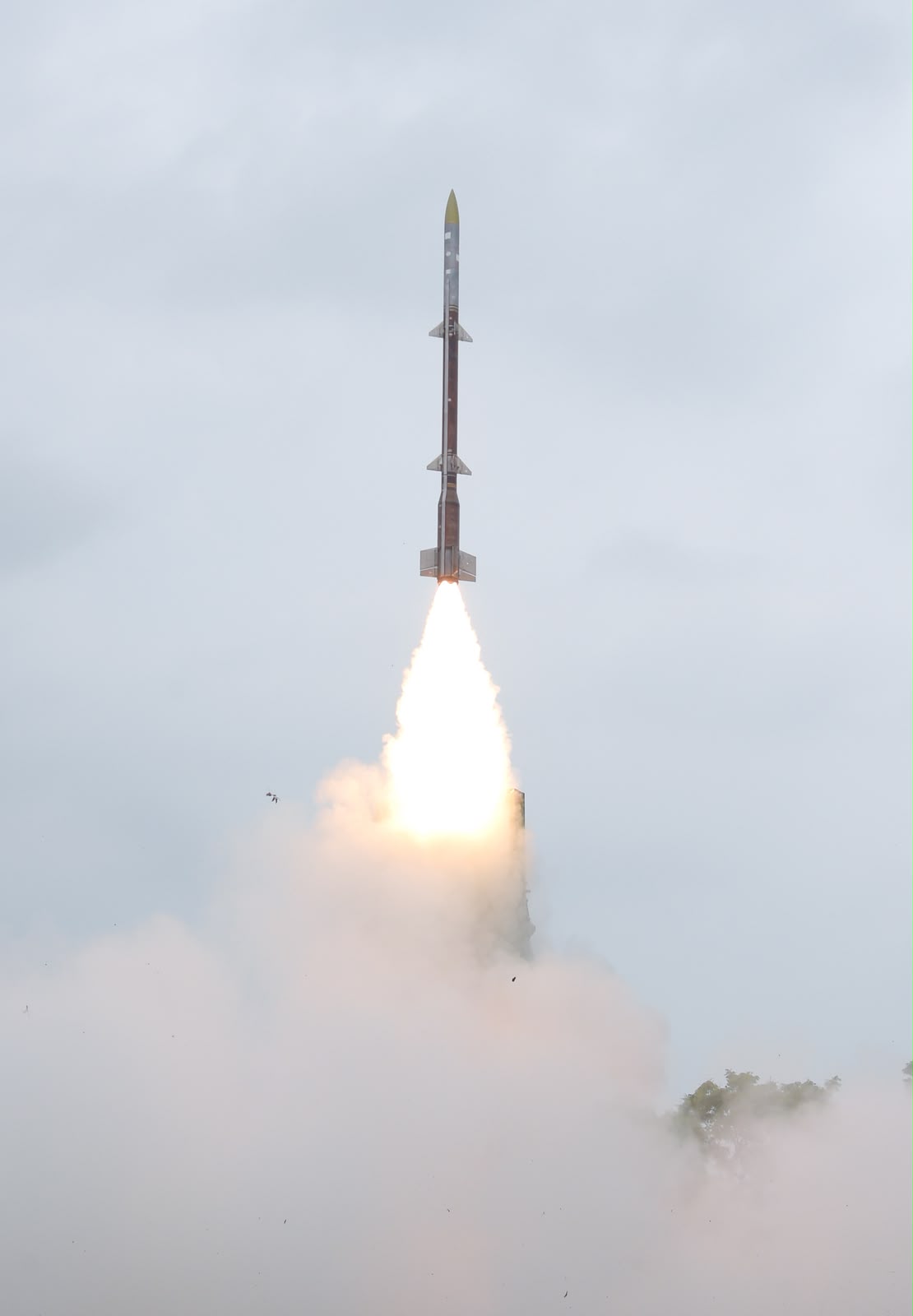
India’s Defence Research and Development Organisation successfully conducted the maiden flight test of the Kusha long-range surface-to-air missile on 23 July 2026 from APJ Abdul Kalam Island off the Odisha coast. The trial intercepted an electronic target simulating a high-speed, high-altitude aerial threat. Defence Minister Rajnath Singh described the result as an important milestone that reduces import dependence for this class of system and places India among the small group of nations able to develop such capability.
Project Kusha is structured around three interceptor variants that share a common kill vehicle while using different boosters to achieve different engagement ranges--the M1 for roughly 150 km, the M2 for 250 km, and the M3 for 350–400 km. The architecture is intended to fill the gap between India’s existing medium-range systems, including the Barak-8 family, and the longest-range coverage currently provided by the Russian S-400. All major elements of the system, the interceptors, radars and command-and-control components, have been developed by DRDO laboratories working with Indian industry partners.
The timing carries strategic weight. India already operates S-400 regiments under a 2018 contract with Russia and has been exploring additional purchases. That dependence has long carried the risk of secondary sanctions under the U.S. Countering America’s Adversaries Through Sanctions Act. An indigenous long-range air-defence layer that can eventually match the outer reach of the S-400 gives New Delhi a hedge. The ability to expand coverage without increasing exposure to external political pressure on every additional regiment.
Kusha forms part of the broader multi-layered air-defence architecture India is assembling under Mission Sudarshan Chakra, scheduled for progressive deployment through the 2030s. The successful first flight of the M1 variant does not yet deliver an operational system but further testing of the M1 and subsequent development of the longer-range variants will do. What the July test does establish is that the programme has moved from design and ground work into flight validation. India has spent years balancing the operational need for long-range air defence against the political cost of relying on a single foreign supplier, that step is the beginning of a genuine alternative.