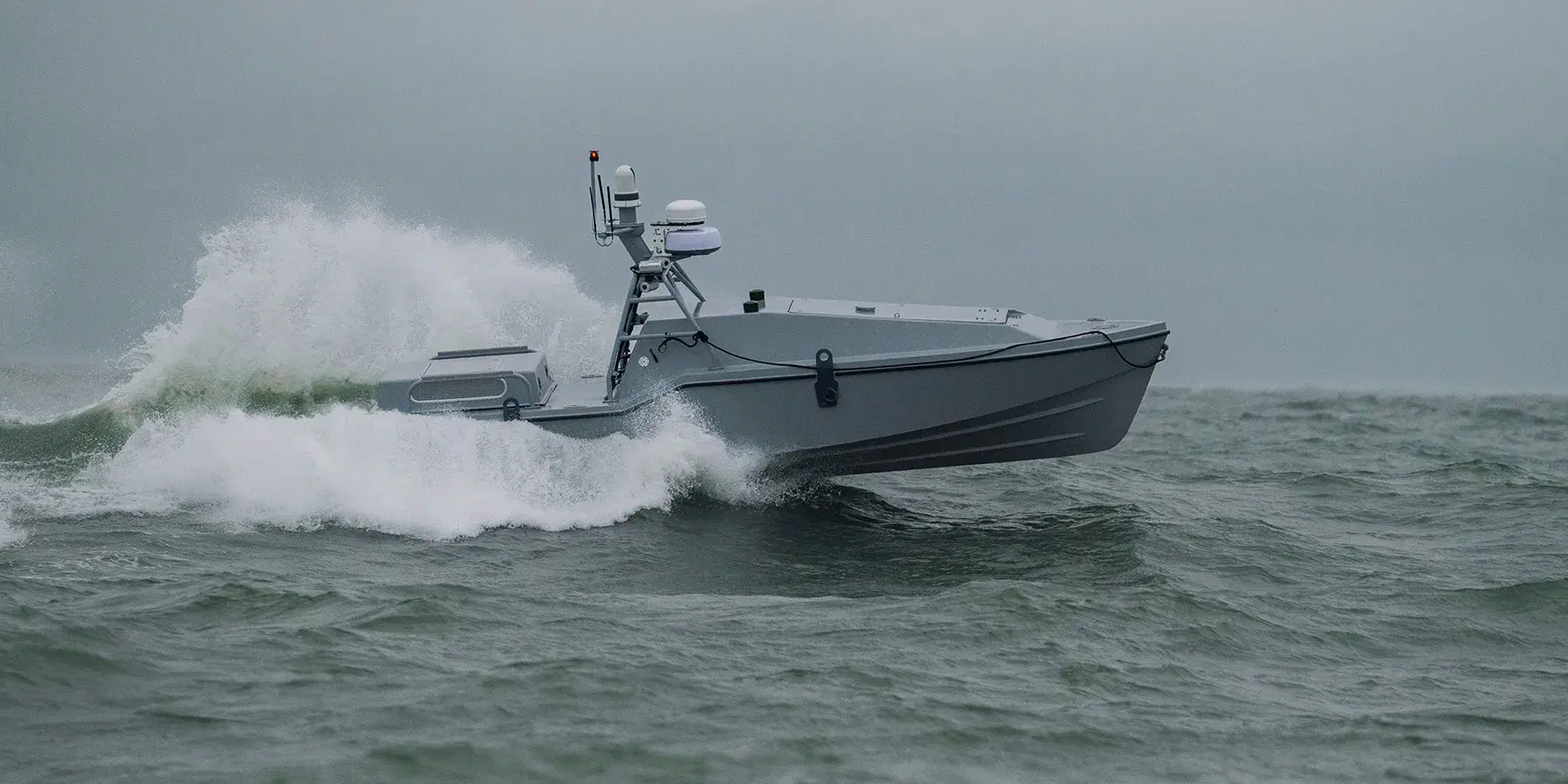
On June 8, near the Strait of Hormuz off the coast of Oman, a U.S. Army AH-64 Apache helicopter was downed during a patrol of regional waters. Two crew members spent approximately two hours in the water before being rescued in what is believed to be the first documented use of an unmanned surface vessel to recover personnel at sea in a real-world U.S. military operation. The rescuer was the Corsair, a 24-foot autonomous surface vessel developed by Texas-based Saronic Technologies and operated by the U.S. Navy’s Task Force 59.
The Corsair, equipped with advanced AI, 360-degree passive sensors, and autonomous navigation capabilities, rapidly located the downed pilots. It approached, picked them up from the water, and transported them to a safer location on the water where they were hoisted aboard a recovery helicopter. Both aviators were reported in stable condition. Later, U.S. Central Command spokesperson Captain Tim Hawkins confirmed the details, noting that Task Force 59 had only begun fielding these vessels in the U.S. Central Command theatre in late March 2026, making the success even more remarkable.
According to Saronic’s official specifications, the Corsair is a 24-foot diesel-powered Autonomous Surface Vessel (ASV) designed for multi-mission operations in contested maritime environments. It is a 1000 nautical miles range with top speed 35 knots(40 mph) with 1000 pounds payload capacity. It supports a wide range of missions, including maritime domain awareness, intelligence, surveillance and reconnaissance (ISR), logistics, and kinetic or non-kinetic effects. The vessel integrates best-in-class hardware, software, and artificial intelligence to operate reliably in blue-water conditions while keeping sailors out of harm’s way.
Saronic Technologies, headquartered in Austin, Texas, is a rapidly growing defence technology company founded in 2022 by Dino Mavrookas (CEO), Vibhav Altekar (CTO), Doug Lambert (COO), and Rob Lehman (CCO). The company focuses on developing scalable, attritable autonomous surface vessels to modernize naval operations and deliver maritime superiority. Saronic emphasizes vertical integration, combining advanced manufacturing with unified AI software platforms across its vessel family (including smaller models like Spyglass and Cutlass, and larger ones like Mirage).
In December 2025, the U.S. Navy awarded Saronic a major $392 million production contract for Corsair vessels under an Other Transaction Agreement. The company has seen explosive growth, closing a $1.75 billion Series D funding round in March 2026 at a $9.25 billion valuation. Saronic’s platforms are designed for mass production and rapid deployment in hundreds or thousands, aligning with the Pentagon’s Replicator initiative and the Navy’s push for hybrid fleets of manned and unmanned systems.
This rescue operation proved the real-world utility of Saronic’s technology and Task Force 59’s innovative approach to integrating unmanned systems. It highlights a shift toward greater reliance on autonomous platforms for high-risk missions, enhancing safety, speed, and operational reach in strategically vital areas like the Strait of Hormuz. As these systems mature, they are expected to play an increasingly central role in future maritime operations.