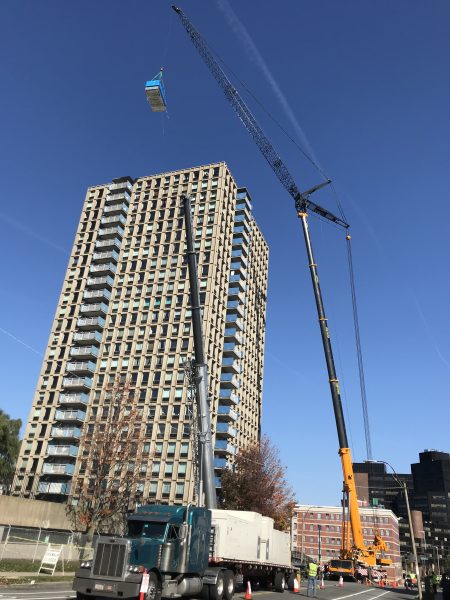
New Zealand’s Civil Aviation Authority has issued a formal determination that a crane at Prices Road in Wiri, Auckland, could constitute a hazard in navigable airspace. The determination under Part 77 of the Civil Aviation Rules sets conditions on lighting, maximum operating height and prior notification to Auckland Airport before the crane may rise above a restricted level. The process is deliberate. An aeronautical study is conducted, stakeholders are consulted and a public determination is published with conditions that remain in force until revoked.
The case is local but the pressure is global. Urban airports increasingly confront temporary and permanent vertical obstacles that penetrate or approach obstacle limitation surfaces. Cranes for high-rise and infrastructure projects, telecommunications towers, laser displays, rooftop plant, drone operations and construction that attracts birds all compete for the same protected volume of airspace that aircraft use for departure, approach and circuit. Obstacle limitation surfaces are not planning preferences. They are safety surfaces derived from international standards that define the free volume required for visual and instrument operations.
India’s major airports are in some of the densest urban growth zones in the world. Mumbai, Delhi, Bengaluru and Hyderabad operate under the Ministry of Civil Aviation’s height-restriction rules and the Airports Authority of India’s NOC process which apply obstacle limitation surfaces and related criteria out to significant distances from the aerodrome reference point. Developers must seek clearances. Enforcement has historically been uneven and the tension between vertical real-estate demand and aviation safety surfaces is a recurring feature of metropolitan planning. Bengaluru’s constraints around multiple aerodromes have been publicly debated as a limit on high-rise development. Mumbai’s obstacle charts list numerous structures that are near or within the controlled surfaces. New rules strengthening the power to address obstructions reflect the same underlying conflict.
Auckland’s formal hazard determination illustrates one regulatory response of transparent notification, aeronautical study and conditional approval that keeps the temporary obstacle visible and controllable. India’s framework relies on pre-construction NOCs, height calculations against published surfaces, and increasingly assertive demolition or restriction powers. Both systems confront the same physical reality. Cities continue to build upward. Aircraft still need clear, predictable approach and departure paths. When those two demands collide, the protected sky becomes contested territory.
The crane in Wiri is therefore not an isolated construction notice. It is an early marker of a wider urban-aviation friction that densifying cities and expanding airport regions will manage for the rest of the decade.