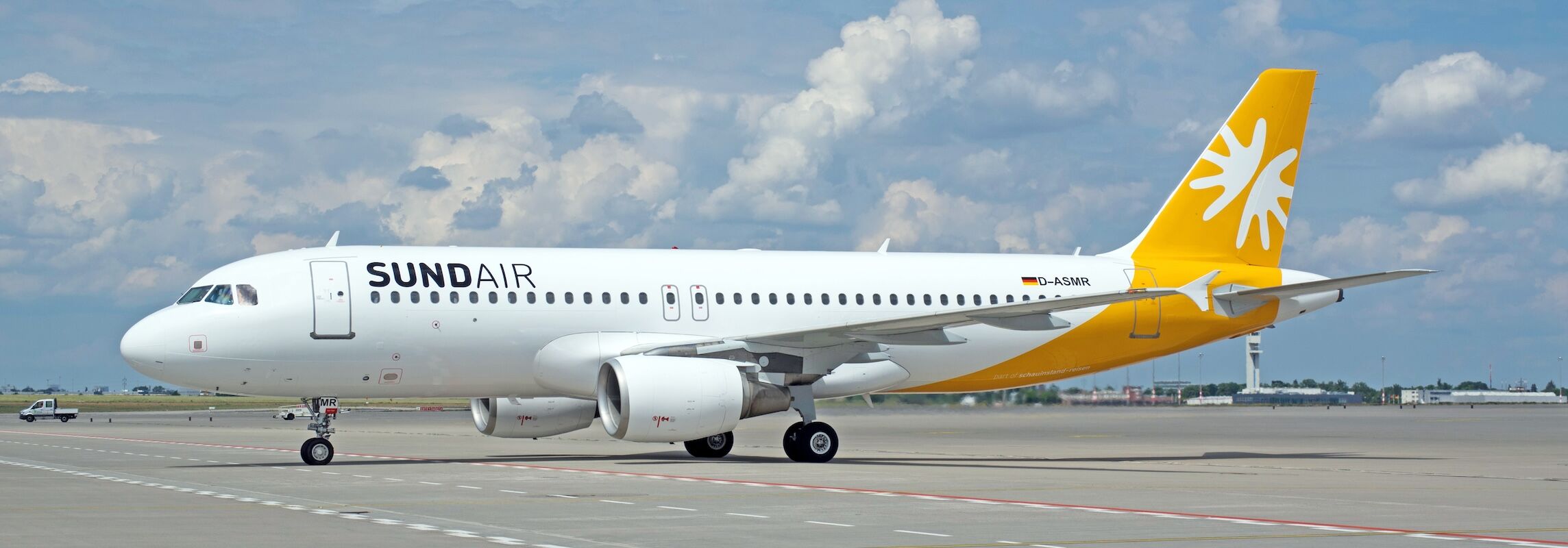
A Sundair Airbus A320 arrived in Damascus from Berlin Brandenburg on 15–16 August, restoring a direct scheduled air link between Germany and Syria after nearly fourteen years. The service is planned twice weekly under a bilateral air-transport agreement signed in mid-July. Syrian and German officials framed the arrival as a practical step toward reconnection, the airline described it as support for personal, economic and humanitarian ties. The flight itself is modest. A single narrowbody on a four-hour sector. Its significance lies less in the schedule and more in the questions it raises about who travels, under what conditions, and whether one restored route can grow into a durable network while political normalisation remains incomplete.
The passenger mix is likely to be heavily shaped by diaspora demand. Germany hosts one of Europe’s largest Syrian communities. Family visits, student travel, medical trips and the movement of people who left during the conflict form a natural base for a direct service that previously required multiple stops or long surface journeys. Humanitarian workers, aid-linked personnel and limited business traffic may add secondary volume. Tourism in the conventional sense remains constrained by security perceptions, infrastructure recovery and residual sanctions considerations. The route therefore begins as a people-to-people corridor rather than a classic leisure or high-yield business market.
Behind the cabin is a more complex operating environment. Insurers must still price risk for flights into and out of Syrian airspace and airports. Sanctions compliance, banking channels and aircraft-handling arrangements have to be navigated with care even when a bilateral agreement exists. Ground handling, fuel, security screening and maintenance support at Damascus must meet the standards required by a European operator and its lessors. A single twice-weekly A320 does not by itself create a robust commercial ecosystem, it tests whether those supporting systems can function reliably enough for the airline to maintain the schedule through seasonal and geopolitical fluctuations.
Other European carriers are already signalling interest in Syrian destinations. A Cologne–Deir Ezzor service is planned, and further links to Aleppo and other points have been discussed. Each additional route multiplies the practical tests-slot coordination, crew rest, spare-parts access, and the willingness of lessors and insurers to expand exposure. For Damascus and other Syrian airports the challenge is to convert symbolic first flights into a network that generates enough volume to justify sustained investment in facilities and procedures. But the challenge is to keep the commercial risk within acceptable bounds while demand is still concentrated in diaspora and humanitarian segments.
Aviation has often moved ahead of formal political settlement. Air links can reopen family contact, enable limited commercial exchange and create facts on the ground that later diplomacy must accommodate. They cannot, by themselves, resolve the deeper questions of security guarantees, reconstruction finance or full diplomatic normalisation. The Berlin–Damascus service is therefore both a practical reconnection and a live experiment. If the aircraft keep flying, the passenger loads hold and the supporting infrastructure proves reliable, the route may become one of several that gradually re-anchor Syria in European air networks. If insurance, sanctions friction or operational reliability intervene, it will remain a symbolic first rather than the start of a sustainable corridor. The answer will be written in load factors, renewal of insurance, and the willingness of other carriers to follow, not in the photographs of the first arrival.
**Sources** Sundair, Berlin Brandenburg Airport and Syrian Civil Aviation Authority statements, SANA reporting and contemporaneous European coverage of the August 2026 resumption of direct Berlin–Damascus flights after a nearly 14-year interruption.