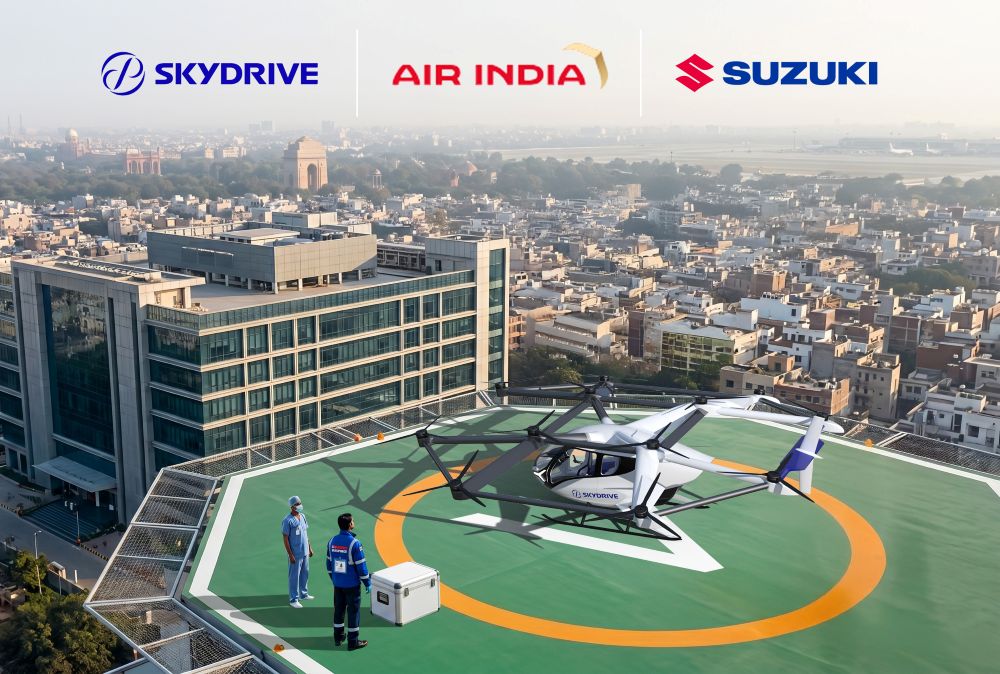
Air India has signed a memorandum of understanding with Japanese eVTOL developer SkyDrive and Suzuki Motor Corporation to study whether electric vertical-take-off aircraft can solve one of India’s most stubborn logistical problems like getting time-critical medical supplies through the congestion of its largest cities.
The agreement announced on 31 July commits the three companies to a joint feasibility study on medical air logistics. The premise is straightforward. In dense urban centres, road traffic routinely delays the movement of blood, organs, vaccines and other high-value, perishable medical cargo. eVTOL aircraft, able to rise vertically and travel above the gridlock, offer a theoretical way to shrink those delays to minutes rather than hours. The study will examine whether such operations can be made safe, reliable and scalable within India’s regulatory and infrastructure realities.
Each partner brings a distinct contribution. SkyDrive supplies the aircraft technology. The company has already demonstrated remotely piloted eVTOL flights in Tokyo and is targeting commercial operations later this decade. Air India contributes operational experience, knowledge of airport infrastructure and established relationships with regulators and airport operators. Suzuki adds deep familiarity with the Indian market and an existing technical collaboration with SkyDrive. Together they aim to map the practical requirements for last-mile emergency medical flights rather than announce an immediate service.
Ramesh Mamidala, Air India’s head of cargo framed the work as a natural extension of the country’s rapidly expanding aviation market. He noted that the potential application combines technology with purpose, reducing critical transit times when every minute can matter. SkyDrive founder and chief executive Tomohiro Fukuzawa spoke of reshaping medical infrastructure in a country where chronic congestion remains a pressing issue. Suzuki’s Masao Fujitani linked the project to the company’s philosophy of smaller, lighter, more focused mobility solutions that stay close to people’s daily needs.
The study itself will test operational concepts, infrastructure needs and the wider ecosystem required before any commercial deployment can be considered. No timeline for actual flights has been published. The announcement is therefore best read as an early, deliberate step rather than a finished plan. India’s cities already struggle with surface congestion that affects emergency services as much as ordinary traffic. Whether eVTOL aircraft can carve out a viable niche in that environment depends on regulation, certification, vertiport infrastructure and the economics of short-hop medical missions. Those questions are precisely what the three companies have now agreed to examine.
For Air India the move extends its cargo ambitions beyond conventional freighters and belly-hold capacity into the emerging field of advanced air mobility. For India’s medical system it raises the possibility, still distant, that the difference between a successful transplant and a lost organ might one day be measured in the time an electric aircraft spends above the traffic rather than stuck inside it.