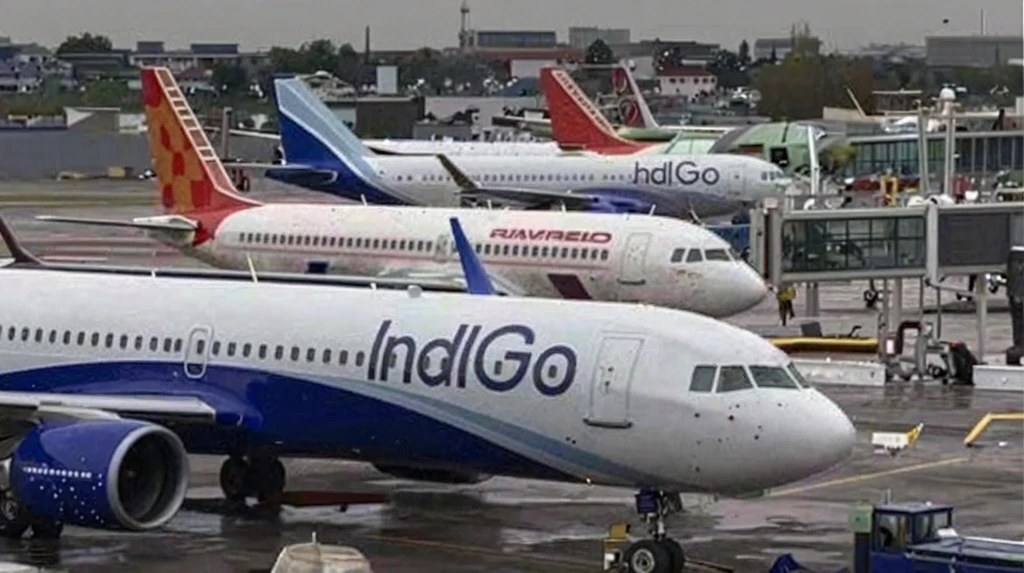
By June 2026, the Indian domestic sky map looks like a long-drawn casualty. Frequencies are thinner, some routes have vanished, and a handful of small airports have dropped off the grid entirely. The cuts are not random, they line up almost exactly with a brutal pressure from fuel, war, and the rupee.
The hard numbers come from Cirium’s schedule data, poured over by analysts and published in late May. In June 2025, Indian carriers operated 22,220 domestic flights a week. In June 2026, they are scheduled to operate 20,670. That is a loss of 1,550 weekly flights, a straight 7% year‑on‑year decline in domestic departures.
You feel it first in the big hubs. At Hyderabad, GMR’s showpiece in Shamshabad, weekly domestic flights drop from 1,791 last June to about 1,420 this June - a cut of 371 flights. That works out to more than 50 fewer departures a day, spread across trunk routes where airlines decide that six daily rotations can be squeezed down to four if fuel and fares no longer match. Another GMR field, Goa–Mopa, sees its weekly domestic schedule trimmed by 106 flights, a sharp deflation of the high‑frequency leisure boom that accompanied its opening.
Further south, at Bengaluru, the Fairfax‑run hub loses 293 weekly domestic flights year‑on‑year. This isn’t a terminal going quiet. Kempegowda will still be heaving at the morning and evening peaks. But the mid‑day departures board is noticeably thinner. One fewer Mumbai rotation here, a scrapped Chennai mid‑day service there, the odd second‑tier city like Nagpur or Jaipur dropping from three daily flights to two. Chennai sheds 279 weekly domestic flights, Mumbai 253, Kolkata 191, and Ahmedabad 111. At Bhubaneswar, Kochi and Varanasi, the cuts are smaller in absolute terms – 96, 84 and 60 weekly flights respectively but they bite harder into overall connectivity because the baseline was lower to begin with.
Airports that had only just moved beyond the one flight a day club are back to zero. Gulbarga and Gondia, both carrying seven weekly domestic flights in June 2025, show no scheduled services at all in June 2026. Ludhiana, which had six weekly flights, disappears from the domestic schedule entirely. Kandla and Porbandar, each with seven weekly flights last June, also go dark. On paper, these are 'temporary suspensions.' In the lives of the people who used those flights to connect to the national grid, they are sudden re‑isolation.
The pattern is reinforced by the airline breakdown. Among the majors, Air India wields the sharpest knife, its weekly domestic schedule falls from 3,696 flights in June 2025 to 2,655 in June 2026 a 28% reduction. SpiceJet trims around 13% of its weekly domestic services, and Air India Express about 10%.
IndiGo, sitting atop the market with the largest network, takes a more measured approach. Its weekly domestic services decline from 13,165 in June 2025 to 12,852 in June 2026 – a cut of about 2.4%. That still means roughly 300 flights fewer a week, but in relative terms it is a diet rather than a crash diet. The outlier is Akasa Air, which moves in the opposite direction, lifting weekly domestic flights from 992 to 1,099, an increase of nearly 11%. As the incumbents pull back from edges and mid‑day slots, the youngest airline in the pack is quietly adding capacity on select routes where it sees room to grow.
All of this is happening against a backdrop that will be depressingly familiar to anyone who has watched airline balance sheets over the decades. Aviation turbine fue* has climbed past ₹1,00,000 per kilolitre in major Indian cities, off the back of crude oil spikes linked to the latest round of West Asia conflict, which escalated again after US and Israeli strikes on Iran in late February. ICRA’s March note pegs fuel at around 40% of airline operating costs, and warns that sector losses could reach ₹17,000–18,000 crore in FY26 as ATF prices, debt servicing and supply constraints all bite at once.
Then there is the rupee. As the dollar strengthens, every dollar‑denominated cost line on an airline’s ledger fattens in rupee terms -aircraft leases, engine overhauls, maintenance contracts, spares, insurance. You can’t re‑negotiate most of those overnight they are locked in. What you can cut, quickly, is capacity.
The timing makes it worse. June is traditionally a lean month for domestic travel. The summer holiday rush is going on. In a year where fuel, war and currency all turn hostile at once, they do what they must to protect cash.
So the map changes. At Hyderabad and Bengaluru, you might simply notice that your usual choice of five departures a day to Delhi is now four. At Goa–Mopa, the weekend schedule to Mumbai and Bengaluru looks less like a shuttle and more like a standard leisure pattern. At Bhubaneswar or Varanasi, you find yourself booking around longer gaps, anchoring your day around a single viable morning or evening departure.
On paper, the Ministry of Civil Aviation can still point to UDAN as a success and to a winter schedule that envisaged 26,495 weekly domestic flights across 126 airports as recently as October 2025. On the ground, June 2026 is a reminder of how fragile those gains are when the arithmetic are.
When jet fuel jumps, the rupee sinks and the global order wobbles, the first instinct is to pull back to core routes and timings, the metros, the high‑yield sectors, the morning and evening waves. Everything else, from mid‑day frequencies at hub airports to thin regional spokes with one flight a day, becomes expendable. The difference this time is 1,550 weekly domestic flights gone, 7% of the network carved away, and entire towns temporarily erased from the aviation map.
The June bloodbath means fewer choices and often higher fares. For airlines, a fuel–war–rupee triple squeeze that their balance sheets were not built to absorb indefinitely. June is also a reminder that in Indian aviation, growth is never a straight line. It is a series of surges and retreats and June 2026 is one of the sharpest retreats in recent memory.