By 6:30 on a humid June morning, the glass facade at Jewar is already catching a pinkish light off the Yamuna Expressway. Inside, the departure board is short enough to read in one glance, but for the people clustered around IndiGo’s counter, it feels like the start of something much bigger.
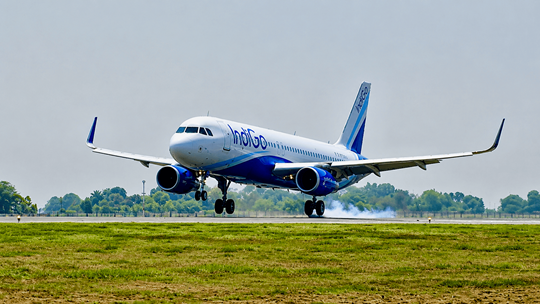
At 7:05 am on June 15, IndiGo’s first Lucknow–Noida flight rotates off runway 27 at Amausi with every seat taken on the way into Noida. Ground staff had watched the booking screen turn green days earlier. The inaugural leg sold out in hours an obvious case. The return, scheduled barely an hour after arrival, tells a more familiar story, a new route still finding its feet, with a sprinkling of empty seats and curious leisure travellers filling in the gaps.
When the Airbus touches down at Jewar fifty minutes later, fire tenders arc the traditional water salute over a runway that can handle 12 million passengers a year in this first phase. The terminal has room to spare. On the apron, there are only a handful of stands in use, but the operator’s slide decks talk confidently about handling four to five million passengers in 2026 alone and scaling to 70 million a year once all phases are built out.
Within twenty‑four hours, the domestic map starts to thicken. IndiGo doesn’t leave Jewar as a single‑line curiosity. It layers in Bengaluru, Hyderabad and Amritsar, turning the white‑on‑blue 6E logo into the airport’s default paint scheme. Boarding calls become more frequent. Morning departures to the south and west, mid‑day returns, late‑afternoon pushes toward the north. What began as a one‑off inaugural quickly acquires the rhythm of a schedule.
On June 16, a different shade of orange taxis onto the same concrete. Akasa’s QP‑2017 rolls in from Navi Mumbai, the first commercial link between the new metropolitan twin on the Arabian Sea and the new gateway in western Uttar Pradesh. The flight leaves Navi Mumbai around 7:30 am and is back by lunchtime, the timing clearly chosen to capture both business travellers and early adopters curious to try a new airport at both ends. Akasa doesn’t stop there, by the next day, it has added Bengaluru into the Noida mix, giving Jewar four Akasa movements a day and staking an early claim as the second tenant in this brand‑new house.
By the end of day two, the scoreboard looks like this, sixteen daily movements, eight arrivals and eight departures. Two airlines, six cities. For an airport that has marketed itself as the second gateway for Delhi NCR, it is a modest start in absolute terms but a clear statement of intent. The terminal feels busy without being crowded. Check‑in agents still have time to pose for photos. Taxi drivers outside are beginning to work out which routes back to Noida and Greater Noida avoid the morning jams.
Up the road, at Indira Gandhi International, the effect of all this is almost invisible, at least for now. IGI is a giant of four runways and a hundred‑plus million annual passengers, easily handling well over a thousand movements a day at peak. The handful of flights that have shifted to or started at Jewar are barely a pixel on its traffic charts. The tower is as busy as always is oblivious of that an A320 is landing at Noida instead of IGI.
But that is not really the point in 2026. The immediate impact of Noida’s opening is less about shaving down today’s numbers at IGI and more about bending tomorrow’s curve. Every passenger from western UP or the eastern NCR who now chooses Jewar instead of IGI is one less person funnelling through Delhi’s already strained terminals and access roads. Every new route that launches at Jewar instead of at IGI, Lucknow, Navi Mumbai, a second or third daily to Bengaluru, is growth that would otherwise have had to be shoehorned into an airport that, even with all its expansions, is running close to the red line on capacity.
From the airlines’ point of view, the region has quietly turned into a two‑runway game board. IGI remains the primary hub, this is where the long‑haul widebodies park, where alliance banks are timed to within minutes, where international connections still overwhelmingly flow. Jewar, in its first incarnation, is a regional and domestic specialist, designed to soak up point‑to‑point demand from a catchment that was tired of crawling ring roads to reach IGI at all.
That duality is new for Delhi but not unprecedented globally. Istanbul has lived through it with IST and SAW, London with Heathrow and Gatwick, Mumbai is about to with CSMIA and Navi Mumbai. The patterns are similar each time. The older airport keeps the prestige and the long‑haul connectivity, the newer one hoovers up low‑cost and high‑frequency regional traffic that doesn’t need a million connection options. Over time, the secondary field often grows into a co‑equal hub in its own right.
The first two weeks at Jewar show both the promise and the problems of that model. On the promise side, the basic concept works. There is clearly enough point‑to‑point demand between Noida’s catchment and cities like Lucknow and Bengaluru to fill an inaugural outbound and rapidly justify multiple daily rotations. For passengers who live within a 30–40 kilometre radius of Jewar, the total door‑to‑door time is already competitive, even before the full slate of planned road and rail links is complete. The airport is not waiting for a decade to find its market, the market was clearly waiting for the airport.
On the problem side, the physics of high‑frequency regional flying show up quickly. Airlines see the temptation. Flood a new airport with multiple short‑haul flights from every major regional centre and 'own' the field before rivals settle in. But those flights need balanced, two‑way demand. A full Lucknow–Noida inaugural and a half‑full return is still not a warning as much as a celebratio. It demands careful schedule tweaks and pricing to build up traffic in both directions instead of burning cash on empty legs. Multiply that across Amritsar, Jaipur, Patna or Indore, and the risk is a patchwork of imbalanced routes that look impressive on a map but fragile on a balance sheet.
There’s also the question of coordination. As more regional spokes feed Jewar, the airport cannot simply operate on a first‑come, first‑served basis. It has to grow its own 'banks' of arrivals and departures if it wants to support serious connectivity. Whether that is domestic‑to‑domestic or, a year or two down the line, regional‑to‑international. Those banks have to be scheduled with one eye on IGI’s waves, another on the airspace above Delhi, and a third on the realities of passenger demand in each city pair. If too many flights are stacked into the same morning and evening peaks, the new relief valve can, ironically, start building its own micro‑congestion.
Beyond the fence, the twin‑airport experiment reaches into the road and rail network. Noida’s reason for being is proximity to the eastern and southern flanks of NCR Noida, Greater Noida, Ghaziabad, the industrial towns along the Yamuna Expressway. For those passengers, a sixty‑minute drive to Jewar is more attractive than a ninety‑minute haul across the city to IGI, as long as the expressways flow and the promised metro and rail connections materialise on schedule. If ground access falters, the advantage erodes quickly, and the argument for running high‑frequency flights into Jewar instead of IGI becomes weaker in the eyes of both passengers and airlines.
In the longer run, it would be hard to imagine that people ever doubted that Delhi will need both airports at full stretch. Demand projections have IGI brushing up against its practical limits with every terminal expanded and every runway optimised. Jewar’s 12‑million‑passenger first phase is designed as a floor, not a ceiling, stepping stone to a 70‑million‑passenger complex that, together with IGI which has made announcements of enhancing its capacity from 105 million to 125, can push the region’s combined capacity into the rare air occupied by the world’s biggest aviation hubs. For regional cities across northern and eastern India, that means routing decisions will increasingly be made against two NCR options, not one--does the morning flight go to IGI for connections, or to Noida for point‑to‑point demand?
Standing in the arrivals hall on that first week, if Jewar is to become more than a ceremonial overflow, its early regional routes will have to graduate from inaugural curiosities to reliable, high‑frequency links that can stand on their own economics. If Delhi’s congestion is truly to be relieved rather than displaced, planners will have to keep the two airports in sync without draining the lifeblood of either. Two weeks in, the story is still in its opening chapter, but it is already one of the most consequential experiments in how India manages the next wave of aviation growth.