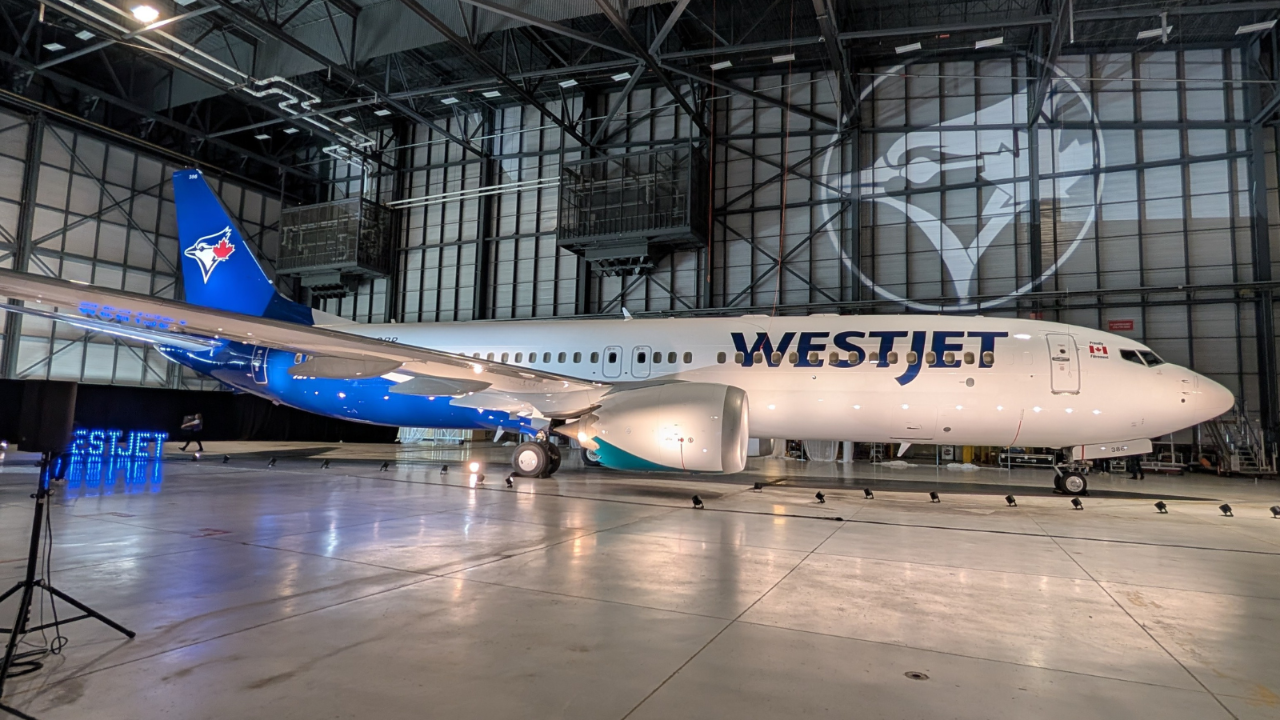
WestJet’s new Toronto Blue Jays 737 MAX 8 is a textbook example of airline and sport branding done with a clear strategy rather than just a paint job and a press release. It also lands in a sponsorship market where aircraft liveries tied to teams now sit inside a global sports branding category worth well over two billion dollars a year.
WestJet is not new to the Jays. The airline has been the official carrier of Canada’s only Major League Baseball franchise since 2012 and in 2025 it extended that partnership by another seven years. The renewal keeps WestJet branding in the Rogers Centre including the WestJet Flight Deck and across Jays spring training in Dunedin and it comes with the usual inventory of broadcast mentions and hospitality. The June 2026 livery takes that long running relationship and moves it onto the most visible piece of hardware the airline owns a Boeing 737 MAX 8 registered C GORP and known internally as tail 386. WestJet unveiled the co-branded aircraft at its Toronto Pearson hangar with around one thousand staff Blue Jays representatives and community guests on hand. The design uses the Jays blue palette and a sweeping pattern that is meant to suggest both the path of an aircraft on takeoff and the arc of a ball leaving a bat. The aircraft’s first revenue flight from Toronto was scheduled for late June with a network brief that emphasises Canada wide connectivity so the livery will be seen from coast to coast rather than confined to one corridor. WestJet’s own language talks about connecting fans and communities and about the aircraft as a symbol of a shared national story.
Seen against the broader sponsorship landscape the move is quite orthodox. Airlines have spent the past twenty years attaching their brands to clubs leagues and tournaments and then painting those relationships onto their fleets. Emirates is often cited as the archetype. Its deal with Arsenal put the Emirates name on both shirts and stadium and the airline followed with themed liveries on A380 and 777 aircraft featuring club branding. The sponsorship gave Emirates a strong footprint in the Premier League and more importantly a global TV presence in markets where the airline wanted traffic for its Dubai hub. The livery worked as a flying billboard and as a talking point for fans when it appeared at London Heathrow or on long haul routes which strengthened recall and association.
Flydubai’s experiments with cricket partnerships have followed a similar logic in a different sport using liveries and campaigns around T20 leagues and national teams to underline its position in markets such as India Pakistan and the wider subcontinent. These deals rarely stand alone. They are designed to support specific route strategies to London to the Gulf to South Asia and to drive awareness and affection in segments that travel regularly.
What makes these partnerships work is not just the logo swap. The best ones align three elements. The geography has to make sense. Emirates with Arsenal makes sense because London is a core market and because Premier League football has a huge following across the Emirates network. WestJet with the Blue Jays works because the team is the only Canadian club in Major League Baseball and because WestJet’s domestic and transborder network can actually take fans to home games and away series. The brand values have to converge. Airlines like to talk about teamwork resilience and aspiration. Sports franchises like to talk about the same. When an airline’s customer service story and a team’s narrative about supporters and community echo each other the partnership feels natural rather than bolted on. Finally the activation has to be visible and layered. A livery is one layer. Stadium signage is another. Joint social media content promotions that tie tickets and flights together and player ambassador deals all contribute. In WestJet’s case YouGov data from 2025 showed a clear uptick in recommendation scores among Blue Jays fans compared to the general population which suggests that the sponsorship was already resonating before the new aircraft arrived.
The failures and misfires are usually the inverse. Partnerships where the airline has little network relevance to the club’s fan base tend to fade. Liveries that are too busy or too literal age badly once a player leaves or a kit changes. Deals that are signed for ego rather than business logic often end up as quiet write downs once management changes. The lesson from Emirates Arsenal and now WestJet Blue Jays is that the paint has to reinforce an existing relationship not attempt to create one from scratch.
WestJet’s Blue Jays MAX fits this pattern very closely. The airline uses the Jays to cement its claim to be Canada’s airline as much as a western carrier and the aircraft becomes a moving emblem of that ambition. It is not a one-off curiosity but part of a broader programme that includes an in stadium presence a branded section at Rogers Centre a player ambassador in Ernie Clement and a renewed multi year rights package. In a crowded sponsorship marketplace that coherence is what separates a genuinely strategic alliance from a fleeting photo opportunity.