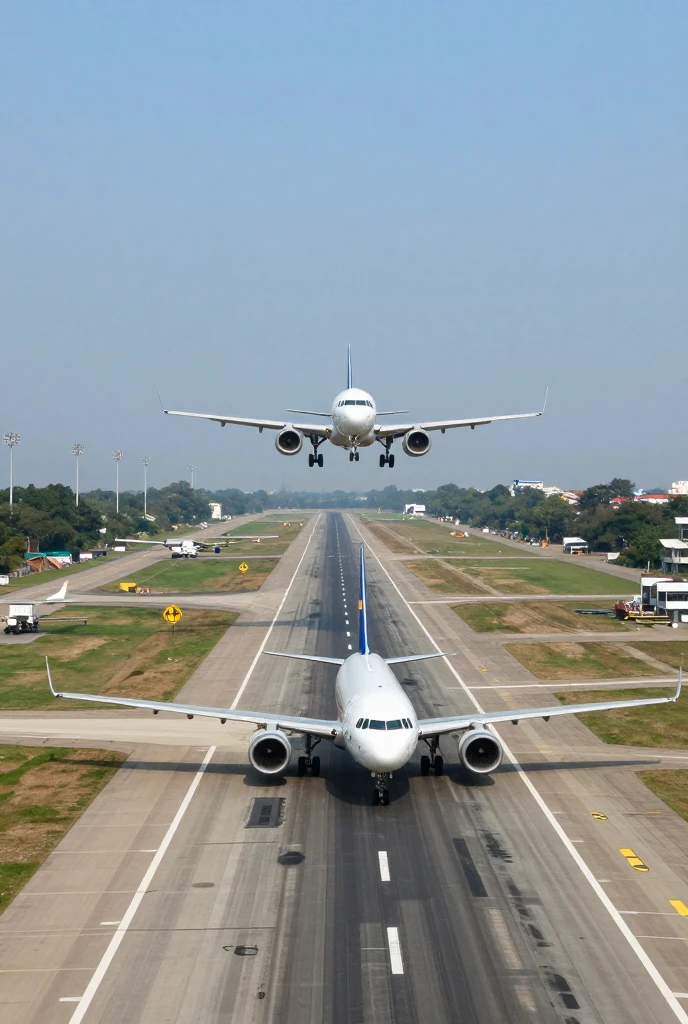
A near-miss on the runway at Mumbai’s Chhatrapati Shivaji Maharaj International Airport earlier this year did not make global headlines for long. There was no collision, no injuries, and the aircraft involved continued their operations after the event. Yet incidents like this reveal something more important than individual lapses. They expose how runway safety is increasingly becoming a systems design challenge rather than a matter of pilot discipline or “gossip” between crews.
Mumbai airport operates with a single runway for most of the day, handling one of the highest volumes of commercial traffic in India. This creates constant pressure on sequencing. Sequencing is the process of spacing arriving and departing aircraft so that only one occupies the runway at any given time. When traffic is heavy, the margin for error shrinks dramatically. A delayed departure, a slow taxi, or a late go-around can quickly compress the separation between movements.
Runway occupancy logic is built on strict timing. Once an aircraft is cleared to land or take off, the runway must be clear of all other traffic within a defined window. In theory, this is managed through precise coordination between air traffic control and flight crews. In practice, at busy single-runway airports like Mumbai, the system operates close to its limits during peak periods. Controllers must thread departures between arriving aircraft while managing taxiway congestion and ensuring that aircraft vacate the runway quickly after landing. Any delay in this chain increases the risk of overlap.
Traffic pressure adds another layer of complexity. Airlines operate under tight schedules, and airports face commercial pressure to maximise runway utilisation. This creates an environment where even small inefficiencies can pile up. A controller may feel compelled to accept a tighter gap between movements to maintain flow. A flight crew, aware of their slot or connection times, may push for an expedited taxi or departure. Individually, these decisions can appear reasonable. Collectively, they can erode safety margins.
Modern aviation already has several tools that can reduce runway occupancy times and improve the safety of sequencing, though many airports, including Mumbai, have not fully deployed or integrated them.
Advanced Surface Movement Guidance and Control Systems (A-SMGCS) provide controllers with a real-time, high-accuracy picture of all aircraft and vehicles on the airport surface. When combined with Runway Incursion Monitoring and Conflict Alerting Systems (RIMCAS), these tools can automatically detect potential conflicts and issue alerts well before a runway incursion develops.
Time-Based Separation (TBS) is another powerful tool. Instead of using fixed distance-based separation between aircraft, TBS adjusts spacing according to actual wake vortex and weather conditions. This allows controllers to maintain safe but more efficient gaps, particularly during strong headwinds, and has been shown to improve runway throughput without increasing risk.
On the technology side, Airport Collaborative Decision Making (A-CDM) helps synchronise airlines, ground handlers, and air traffic control so that aircraft are ready to depart when their slot becomes available. Better pre-departure sequencing reduces last-minute delays on the taxiway, which in turn prevents aircraft from occupying the runway longer than necessary.
Rapid Exit Taxiways (RETs) and improved taxiway infrastructure also play a direct role. When aircraft can vacate the runway faster after landing, the runway becomes available sooner for the next movement. Mumbai’s current layout has limited rapid exits in certain configurations, which contributes to longer runway occupancy times.
Newer digital tools are also emerging. Some airports are testing AI-assisted sequencing tools that predict optimal departure and arrival order in real time, taking into account aircraft performance, taxi times, and controller workload. These systems can suggest adjustments that human controllers might miss during high-pressure periods.
Improving runway safety at airports like Mumbai will require more than reminders about standard operating procedures. It will need honest assessment of capacity versus infrastructure, wider deployment of surface surveillance and conflict alerting systems, and operational changes that reduce the pressure to squeeze extra movements into already tight windows.
Redesigning the operating environment with better tools, infrastructure, and procedures will make safe operations the easier and more natural outcome.