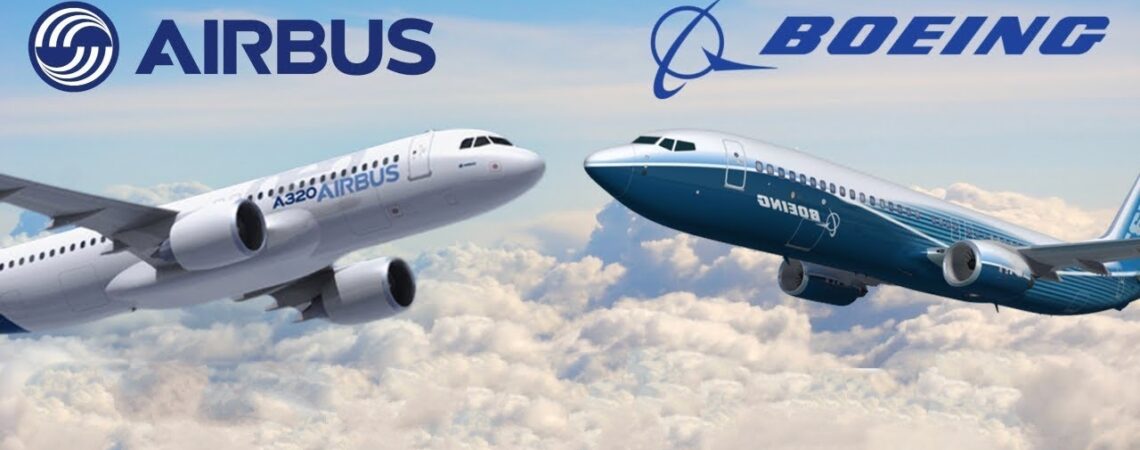
Farnborough closed this week with the thinnest commercial order tally in recent memory. Boeing edged Airbus 173 to 154 in firm and tentative commitments, a combined haul of roughly 327 aircraft that fell far short of the 600 to 800 some forecasts had dangled before the gates opened. The scoreline itself matters less than the contraction it signals. For the first time this decade, the industry’s biennial order has visibly cooled even as carriers continue to speak of fleet expansion.
The largest single transaction came not from an airline but from lessor SMBC Aviation Capital, which split 200 narrowbodies evenly between the two manufacturers. One hundred Boeing 737 MAXs including a substantial block of the still-uncertified MAX 10, and one hundred Airbus A320neo-family jets, skewed toward the A321neo. Those deliveries stretch into the early 2030s. AerCap added 15 Boeing 787-9s. Riyadh Air converted options into more Dreamliners and a handful of additional A350-1000s. Philippine Airlines signed for 15 firm 787-10s plus rights, and a day later, an MoU for nine more A350-1000s. Uganda Airlines, Luxair, MSC Air Cargo and a scatter of smaller carriers filled the remaining columns. Embraer collected a respectable if secondary haul of E-Jets. No flagship order from Singapore Airlines, Etihad, American, Qantas or Ethiopian materialised.
What looks like a narrow Boeing victory on a shrinking floor is better read as evidence of structural change. Both manufacturers already carry backlogs that run deep into the next decade. Airbus with near 9,200 aircraft of backlog. Boeing’s commercial backlog exceeds 6,800. Production rates remain constrained by lingering supply-chain friction and the slow certification of Boeing’s final MAX variants and the 777X. Delivery slots for new narrowbodies are scarce before the early 2030s. Airlines that still want growth therefore lean on lessors, who absorb the capital risk and the calendar risk.
Three things compete. First, pure supply caution. When factories cannot accelerate output, additional firm orders buy little more than a later place in a long queue. Second, residual fuel-price wariness and the memory of recent demand shocks. Carriers prefer flexible lease arrangements over large balance-sheet commitments that lock them into aircraft whose economics may shift with the next oil spike or traffic downturn. Third, and most interesting, the possibility that genuine demand softening is beginning to register in the order books themselves. Passenger traffic has recovered yet the pace of capacity growth is uneven across regions and some markets show signs of yield pressure. The absence of the expected mega-orders from major network carriers is consistent with all three readings.
Executives spent more time discussing production ramp-ups and certification milestones than chasing new logos for the chalet walls. Airbus still targets roughly 870 deliveries this year and is studying the industrial changes needed to exceed 1,000 annually by decade’s end. Boeing’s leadership emphasised clearing the existing backlog rather than inflating it further. The airshow, once a stage for theatrical announcements, has become a quieter venue for managing scarcity.
It is not the narrow numerical win for Boeing. It is the visible contraction of the industry’s collective order appetite at a moment when fleet-growth rhetoric remains widespread. Whether that contraction proves temporary, the product of supply bottlenecks and capital discipline, or the first clear signal of softer underlying demand will become clearer only when the next round of delivery-slot negotiations and lessor placements is complete. For now Farnborough has recorded the subdued commercial scoreline in years and the industry is left to decide what the silence means.