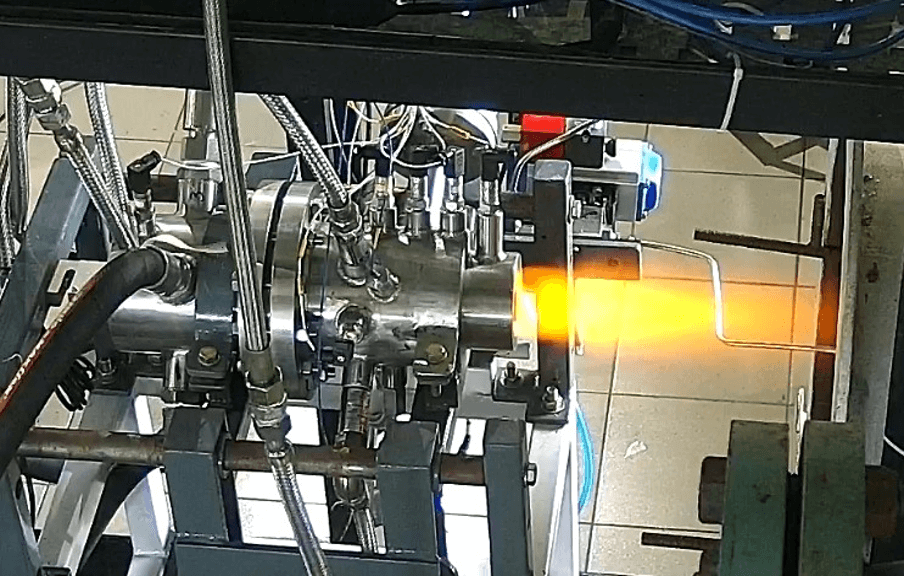
An Indian startup has crossed a consequential threshold in propulsion. D-Propulse incubated at IIT Madras, has demonstrated a stable 5 kilonewton thrust from an air-breathing rotating detonation engine fitted with an aerospike nozzle. The hot-fire runs took place on 21 and 22 July at a DRDO facility in Hyderabad and lifted the system to Technology Readiness Level 5. That rating means the core architecture has left the laboratory and performed under conditions that approximate real operation.
Rotating detonation engines replace the steady subsonic flame of conventional combustors with a continuous supersonic detonation wave that races around an annular chamber. The pressure-gain process yields thermodynamic efficiencies 15 to 25 percent higher than traditional air-breathing designs. There are no turbines inside the combustor so the mechanical architecture is simpler and the manufacturing path runs through precision machining rather than complex rotating assemblies. The aerospike nozzle adds altitude compensation that a conventional bell nozzle cannot match keeping efficiency across a wider range of ambient pressures.
Founder and chief executive Saurav Jha, working with co-founder and former DRDO scientist V. Ramanujachari describes the result as India’s first indigenous demonstration at this thrust class. The engine produced the measured 5 kN even under deliberately reduced air-mass flow, suggesting headroom remains. The company has set December 2027 as the target for a flight-ready article and December 2029 for military user trials. Intended applications sit in the cruise-missile, target-drone and high-speed unmanned range, where a compact, efficient air-breather of roughly this thrust class already powers several existing systems.
Funding has come from private capital. In January the IAN Alpha Fund placed ₹25 crore into the firm to expand the engineering team, deepen simulation capacity and build limited test infrastructure. Mentorship includes former DRDO chairman V.K. Saraswat and combustion specialists at IIT Madras. No large government development contract has yet been announced though the choice of a DRDO test stand for the recent runs signals institutional interest.
Realistic timelines remain long. Global rotating-detonation programmes, most of them still at lower thrust or shorter burn durations, have yet to field an operational engine. Moving from a ground-tested 5 kN prototype to a flight article requires sustained multi-second burns thermal management under continuous detonation, inlet integration, control of wave stability across the flight envelope and qualification for vibration, shock and temperature extremes. Even optimistic schedules place operational systems several years beyond the 2027 flight-ready milestone. Yet the Indian effort now stands among a very small group of teams worldwide that have produced measurable continuous thrust at this scale with an aerospike.
The achievement is therefore less a finished product than a proof that pressure-gain combustion can be engineered in India at useful thrust levels. Whether it becomes a deployable propulsion option for the next generation of Indian air-breathing weapons and drones will depend on the pace of subsequent testing, the willingness of the services to fund further risk reduction, and the ability of a small private team to keep the detonation wave turning under flight conditions. For the moment D-Propulse has given the country’s propulsion community a concrete data point rather than another paper study.