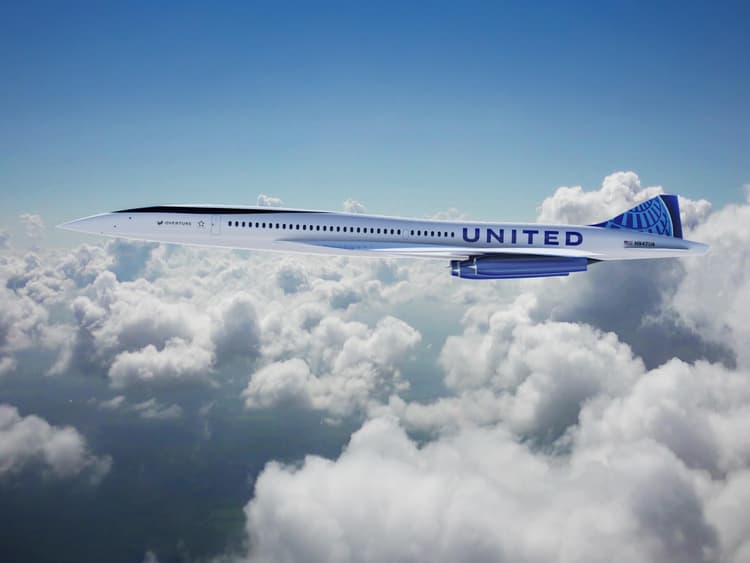
Remember Concorde which started its first flight in 1969, doesn't it look like that future happened in the past. It flew at an unimaginable speed Mach 2.04(double than the speed of sound) and would take 3.5 hours between London New York. Yes, supersonic flight is coming back to civil aviation, but not in the way most people imagine.
The headlines are for Boom Supersonic’s Overture a 65–80‑seat airliner pitched at carriers like United and American. The real experimentation is happening in a quieter corner of the market, where a handful of companies are trying to build supersonic business jets for a very specific clientele. Those who do not take a $10,000–$15,000 one‑way ticket between New York and London outrageous, and for whom time is worth more than cabin size.
This is the return of supersonic business aviation.
Boom’s Overture is designed as an airline aircraft. Think of it as Concorde 2.0, but optimised for today’s economics and regulations like Cabin around 65–80 seats, all‑premium layout and scheduled services by major airlines on trunk transatlantic and transpacific routes to aim for ticket prices similar to today’s business class, spreading operating cost over dozens of seats.
A supersonic business jet is built around entirely different design and market assumptions. It has a cabin of 8-18 passengers with large-cabin business jet layout and is for ultra-high-net-worth individuals and corporates or may be a charter company runs it that way. But for ticketed passengers between 10000 to 15000 Dollars one way.
The first wave: Aerion’s rise and collapse
Aerion Supersonic, backed at various points by major OEMs, was the first modern company to make serious progress on a supersonic business jet. Its AS2 concept aimed for cruising around Mach 1.4 to 1.6 for 10-12 passenger range.
Aerion invested heavily in boomless cruise. It signed high‑profile MoUs and LOIs. Then the economics caught up. Development costs in the billions, engine availability questions, and the difficulty of raising enough capital led to Aerion shutting down in 2021.
Aerion’s collapse did not kill the idea. It mostly proved that Supersonic + business jet + private funding is a very hard equation if you try to carry all the risk yourself. It also left a lot of talent, design thinking and market research floating around for other players to pick up.
The current players: Spike, Exosonic and others
Today, several startups are pursuing the supersonic business‑jet niche, often with quieter, more targeted campaigns than Boom.
Spike Aerospace has long promoted its S‑512 concept. A low‑boom supersonic business jet with no windows (using large interior displays instead), aiming for cruise around Mach 1.6 and a cabin suitable for 12–18 passengers. Its pitch is explicitly focused on private and corporate users-people who will pay for time and prestige, not mass‑market routes. Exosonic has explored supersonic aircraft designs with both military and civil applications, including VIP transports. Their messaging emphasises low‑boom technology and compliance with future noise regulations, again aimed at high‑value missions rather than scheduled airline work.
Other conceptual programmes and design houses exist in various stages (some oriented towards government or defence VIP contracts, others at ultra‑luxury operators), all essentially circling the same idea 'to build a jet that gives business‑jet customers Concorde‑like block times without trying to be a 70‑seat airline workhorse.'
These projects are not yet flying prototypes in service. They are, however, building the design language and regulatory dialogue that could make a small, quiet supersonic jet easier to certify than a large airliner.
But why the business‑jet niche makes sense first? From a cold economic and regulatory standpoint, supersonic business jets may be more tractable than supersonic airliners in the near term. Because ultra‑rich and corporate clients already pay five‑figure sums for premium travel and fractional ownership. Asking $10,000–$15,000 for a 3.5‑hour New York–London supersonic leg is within that world. For airlines, scaling that pricing to a full cabin and competing with lie‑flat business class is harder.
On the top of it fleet size and risk is minimal because a business‑jet programme can reach break‑even at hundreds of units than a supersonic airliner. More so, it has flexibility of accessing secondary airports and use private terminals and it can get faster approvals.
In fact, the private-jet to offer higher revenue per seat, lower required production scale and operational flexibility.
Boom’s Overture, in that sense, is the visible tip of a larger movement but it is the business‑jet developers who may quietly solve many of the hard practical questions.
If supersonic business aviation takes off, it shall have a network spread like New York-London, New York-Paris, Los Angeles-Honolulu, Tokyo-Sydney, Dubai-Singapore become core supersonic links for private clients. There will be membership-style access to the supersonics and shall also be used by government, defence and emergency travel needs.
Over land, flights stay subsonic to comply with boom regulations. Over water, they go fast. The aircraft themselves look more like elongated Gulfstreams than like mini‑Concordes with careful shaping to control shock waves and cabin layouts tuned to productivity and privacy not volume.
In that world, traditional business jets do not disappear. They coexist. Supersonic becomes the top tier of business aviation deployed when time and signalling matter most.
Concorde gave supersonic civil flight a first life. It was glamorous, loud, and ultimately unsustainable at the scale it tried to reach. The second life seems more likely to begin not with 70‑seat airliners full of champagne but with quiet cabins, small fleets.
Boom’s Overture will keep the cameras pointed at the airline side. But if supersonic business jets cross from concept to certified reality, the real shift may happen in the background, in boardrooms and private terminals, in a handful of jets that redraw the mental map of what 'a day trip' between continents looks like.
In the shadows of the big announcements, when will passengers ever see actual 'Supersonic' on a booking screen, is something that we are exploring.